
Complaints and trust evidence
Caspero complaints and trust signals: how to read the evidence
 Available in AU
Current Caspero complaint material includes several withdrawal-related cases, but those records are individual disputes rather than a universal description of every player’s experience. The strongest way to interpret them is to check the date, disputed amount, operator response and final resolution status, then compare the allegation with current official terms and regulator information. As of 18 September 2026, AskGamblers shows multiple resolved withdrawal cases and one unresolved large withdrawal dispute. That pattern makes withdrawals an important area to examine, but it does not establish a normal payout time, a failure rate or an overall trust score for Caspero.
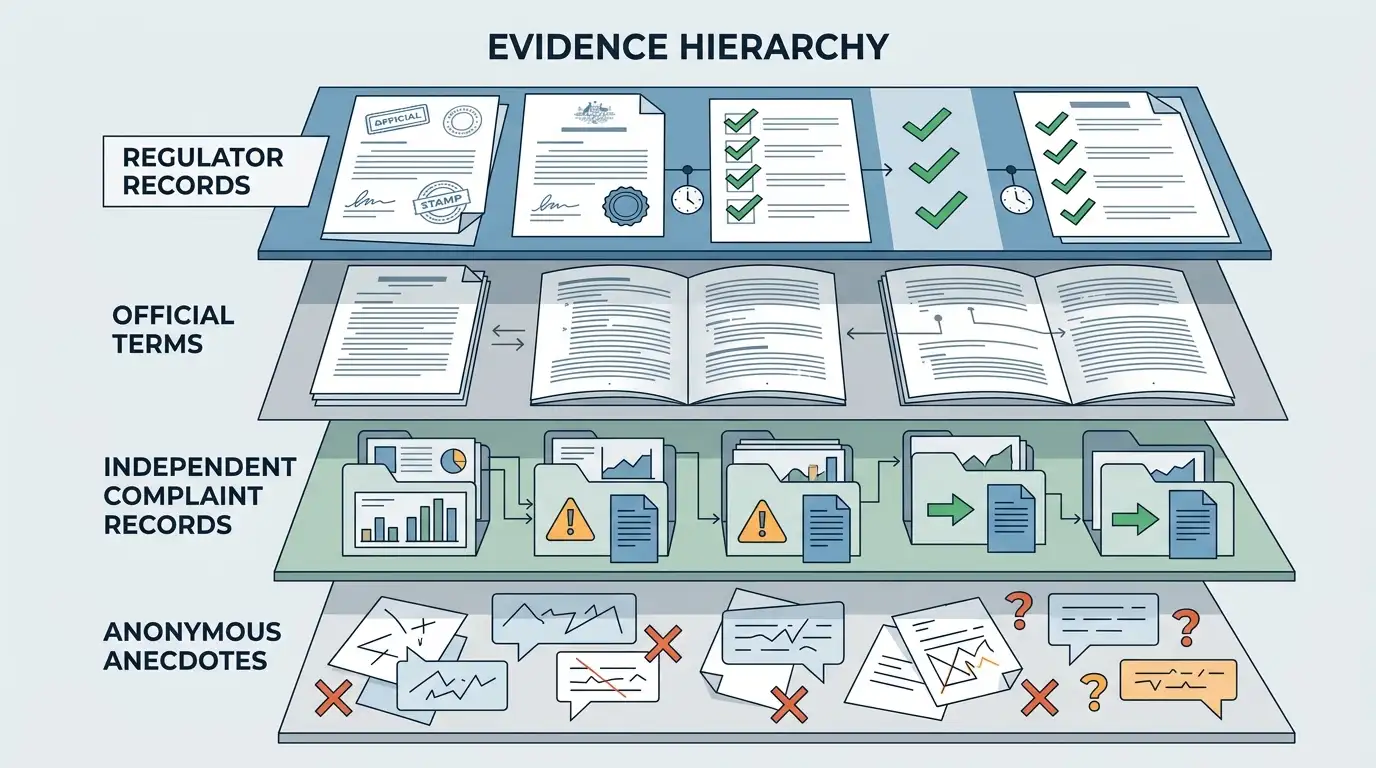
Table of Contents
- Complaint headlines are the start of the evidence, not the conclusion
- Use an evidence hierarchy before deciding what a complaint means
- What the current Caspero complaint archive actually shows
- A resolved delayed-withdrawal case shows why follow-up matters
- Other resolved withdrawal complaints reinforce the topic, not a universal rule
- The unresolved case should be treated as a serious case, not a universal verdict
- Resolution status is only useful when the date is visible
- Structural trust signals belong beside complaint records
- Support availability and support effectiveness are different questions
- Do not use a review site’s closure label as a standalone current-status claim
- Questions to ask before relying on a Caspero complaint
- A complaint log is more useful than a trust score
- How to weigh Caspero complaints against current evidence
Complaint headlines are the start of the evidence, not the conclusion
A complaint page is valuable because it records a concrete dispute and often preserves dates, amounts and follow-up messages. It is weaker when a reader treats the original allegation as the final outcome. A delayed-withdrawal complaint can later be marked resolved after payment, while another dispute can remain unresolved. Those two results should not be collapsed into the same category.
For Caspero, the current AskGamblers archive contains several withdrawal-related complaints. That is enough to justify paying attention to cashout handling and documentation. It is not enough to claim that every withdrawal is delayed, that all withdrawals are paid, or that a single stated limit applies to Australian users. The Caspero withdrawals guide keeps those operational questions separate from complaint interpretation.
Use an evidence hierarchy before deciding what a complaint means
| Evidence level | Best use | Main limitation |
|---|---|---|
| Regulator or official legal source | Licence status, Australian regulatory scope and formal rules | May not describe an individual account dispute |
| Current operator terms or account interface | Current process, support routes and transaction conditions | Operator-published information is not independent evidence |
| Independent complaint record with updates | What one player alleged, how the operator responded and whether the case closed | Still anecdotal and case-specific |
| Anonymous post without documents or follow-up | Possible lead for further checking | Weak basis for a factual conclusion |
This ordering prevents a common mistake: using the most dramatic anecdote as though it overrules regulator records or current terms. It also prevents the opposite mistake of ignoring a documented complaint merely because an operator page describes fast service.
What the current Caspero complaint archive actually shows
AskGamblers currently lists six Caspero complaints in its complaint statistics, with five marked resolved and one marked unresolved. Several concern withdrawal delays, cancelled withdrawal requests or stopped payouts. The archive therefore supports a narrow statement: withdrawal handling is a recurring topic in the available complaint material.
The statistic should be read cautiously. Six cases are not a representative sample of all customers, and complaint platforms attract users precisely when something has gone wrong. A high resolution count also does not erase the inconvenience described in the original disputes. The useful question is what happened in each case from first complaint to final status.
A resolved delayed-withdrawal case shows why follow-up matters
One complaint filed in 2026 described repeated cancelled withdrawal requests and a disputed amount of EUR 3,900. The player reported that requests were being cancelled after several working days. Later updates on the complaint page state that partial payment arrived, then the player confirmed receiving all funds. AskGamblers closed the complaint as resolved.
That sequence supports two separate facts about the case: the player reported a material delay and cancellation problem, and the complaint later ended with the player reporting full payment. Reporting only the opening allegation would omit the resolution; reporting only the resolution would omit the dispute that triggered the complaint.
Case-reading rule
Always capture both the opening allegation and the latest dated outcome. A complaint that changes status over time can tell a very different story from its headline alone.
Other resolved withdrawal complaints reinforce the topic, not a universal rule
The archive also contains a complaint about two withdrawals totalling EUR 370 that was later marked resolved, and another complaint describing a week-long wait for a EUR 500 withdrawal that was also marked resolved. A separate EUR 4,000 payment complaint is shown as resolved as well.
Taken together, those entries justify grouping delayed withdrawals as a recurring complaint theme in the available record. They do not justify publishing a standard Caspero withdrawal time, cancellation rate or Australian payout limit. The amounts, currencies and timelines belong to individual cases and may reflect different account histories, payment methods or verification circumstances.
The unresolved case should be treated as a serious case, not a universal verdict
AskGamblers also shows one large withdrawal dispute as unresolved. The complainant described a substantial balance, verification requests and stopped payouts. The page remains marked unresolved in the current archive. That is a meaningful negative trust signal because the dispute did not reach the same closure recorded for the five resolved cases.
It is still one case. The disputed amount and the unusual size of the claimed winnings make it especially inappropriate to convert the complaint into a normal-user benchmark. A careful reader should note the unresolved status, the allegations and the absence of a recorded resolution without claiming that the same outcome is typical for Caspero users.
Resolution status is only useful when the date is visible
Complaint records age quickly. A case that was unresolved last month can later close, and an operator’s terms can change after the complaint occurred. For that reason, the date of the complaint and the current status should be kept together whenever the case is cited.
This page was checked on 18 September 2026. A future reader should re-open the complaint archive rather than assuming the five-resolved, one-unresolved snapshot is permanent. The same freshness rule applies to licensing and operator information.
Structural trust signals belong beside complaint records
Caspero’s current public site identifies Nova Forge Ltd as the operator and states that the casino operates under an Anjouan licence. It also advertises 24/7 live chat and email support. Those are concrete structural facts that can be checked against the site and independent sources.
They do not amount to an Australian licence. ACMA’s licensed interactive gambling provider register is the relevant Australian reference point, and no Australian local licence was verified for Caspero or Nova Forge. The licence and rules page explains the Australian regulatory context in detail rather than mixing it into complaint scoring.
Support availability and support effectiveness are different questions
Caspero publishes live chat and email as support channels, which means users have documented routes for asking about an account or transaction. A complaint can still allege that a response was slow, generic or insufficient. Those are not contradictory statements: a support channel can exist even when an individual customer is dissatisfied with the answer.
When reading a complaint, look for evidence that the user contacted the correct channel, whether the operator responded, whether the response addressed the issue and whether the case later changed status. If you are documenting your own issue, keep timestamps and reference numbers. The support and account checks guide covers the account side without turning complaint anecdotes into general policy.
Do not use a review site’s closure label as a standalone current-status claim
AskGamblers’ Caspero review page currently carries a closure signal, while the Caspero-branded website remains accessible and continues to publish operator, game, payment and support information. Because those signals conflict, this page does not state that Caspero is definitively closed or definitively operating for every location.
This is a useful example of why freshness checks matter. A directory label can lag behind a reopening, migration or site-status change, while an accessible website can itself be outdated or restricted by geography. Current availability should therefore be checked separately from complaint quality and licence status.
Questions to ask before relying on a Caspero complaint
- When was it filed? Older cases may refer to terms or processes that have changed.
- What exactly was disputed? Record the amount, method and stated reason without generalising it.
- Did the operator answer? Separate silence from a response that the player found unsatisfactory.
- Was verification involved? Note it only for that case unless current terms establish a broader rule.
- What is the final status? Resolved and unresolved cases carry different evidentiary weight.
- Can the claim be cross-checked? Compare it with current terms, support information and regulator records.
A complaint log is more useful than a trust score
A single numerical trust score hides the evidence that matters. A short log is better: date, issue, amount, operator response, final status and the current rule or term that relates to the dispute. That format shows whether several cases actually share a theme or merely look similar at headline level.
For Caspero, the available material does show a cluster around withdrawals. It does not provide enough representative data to calculate a reliable probability of delay or non-payment. Keeping the analysis descriptive protects readers from both sensationalising negative cases and dismissing them too quickly.
How to weigh Caspero complaints against current evidence
The strongest current picture combines sources rather than choosing one. Caspero identifies Nova Forge Ltd, claims Anjouan licensing and publishes live chat and email support; no Australian local licence was verified; and the independent complaint archive contains several withdrawal disputes, mostly resolved, plus one unresolved large case. That mix gives Australian readers specific issues to investigate without supporting a blanket statement that Caspero is trustworthy or untrustworthy. Recheck the complaint status, current terms and regulator information at the time you make a decision, especially where money is already pending. For the wider product context, return to the Caspero Australia review.
Prepared by the Caspero Casino editorial staff.